
Commercial Roofing for Public Agencies in Menifee
Home / Industries We Serve / Commercial Roofing for Public Agencies in Menifee
A ceiling stain above a public counter is a clue, not a work order boundary. We trace the water route from the room to the roof, then record which department controls access, who can authorize testing, and what service must remain open. A library, operations yard, office, and public-safety building may each have different access rules and roof assemblies. A useful first visit identifies those differences before anyone prices a repair.
The agency can gather prior inspection notes, warranty documents, work orders, and roof plans before the appointment. Missing drawings do not prevent an inspection, but they change how the field team documents dimensions and test locations. We mark the observed condition, distinguish verified damage from an untested suspicion, and show the repair boundary separately from the condition of the larger roof. That separation gives procurement and facilities staff a factual basis for the next decision.
Records
Start with an asset record that can survive a staff handoff. For each building, list the known roof system, approximate installation history if documented, warranty contact, drain locations, access method, and unresolved leak reports. Label photos by building and roof zone rather than by a department nickname that may change. When a repair ticket says only “west office leak,” add the room, ceiling location, date noticed, and whether water appeared during rain or later.
An inspection report should preserve the difference between an observation and an inference. A lifted edge is visible; the exact path beneath the membrane may require a controlled test. We identify the next check and state what result would confirm the suspected entry point. For an agency managing several properties, a portfolio view can prioritize urgent water control while retaining a separate record for every site. A multi-site roof program provides one way to structure recurring records.

Protect Public Access
Before roof access, identify public entrances, accessible paths, loading points, service windows, and the staff member who can escort a crew. A lift route or barricade should not block an emergency lane or an entrance used for benefits, records, permits, or public meetings. The agency confirms any restricted rooms, security screening, sign-in requirements, and photography limits before the inspection. If a route changes on the day of work, the crew pauses until the new path is approved.
Work near a public service area can often be sequenced without closing the whole building, but the boundary must be specific. Mark the roof zone above the room, the area on the ground below, and any temporary interior protection. Give staff a clear time for setup and removal of barriers. The person who reopens the public area should receive a short handoff describing what was tested, what remains isolated, and whom to contact if water returns.
Write a Comparable Scope
Procurement staff need a scope that describes an observable result, not just a generic “repair roof” line. The bid package should identify the roof area, existing assembly where known, access assumptions, temporary weather protection, disposal, testing, and acceptance documents. If concealed wet insulation is possible, write an allowance or unit-price method that requires approval before expansion. The change record should include the new boundary and the evidence that triggered it.
Compare proposals against the same scope map. One contractor may include a drain reset while another prices only membrane patching; those totals are not equivalent. Ask each bidder to identify exclusions such as interior finish work, electrical disconnection, hazardous-material testing, or structural review. This helps the agency route each item to the correct department and keeps a low initial figure from masking an incomplete work sequence.
Inspect Roof Interfaces
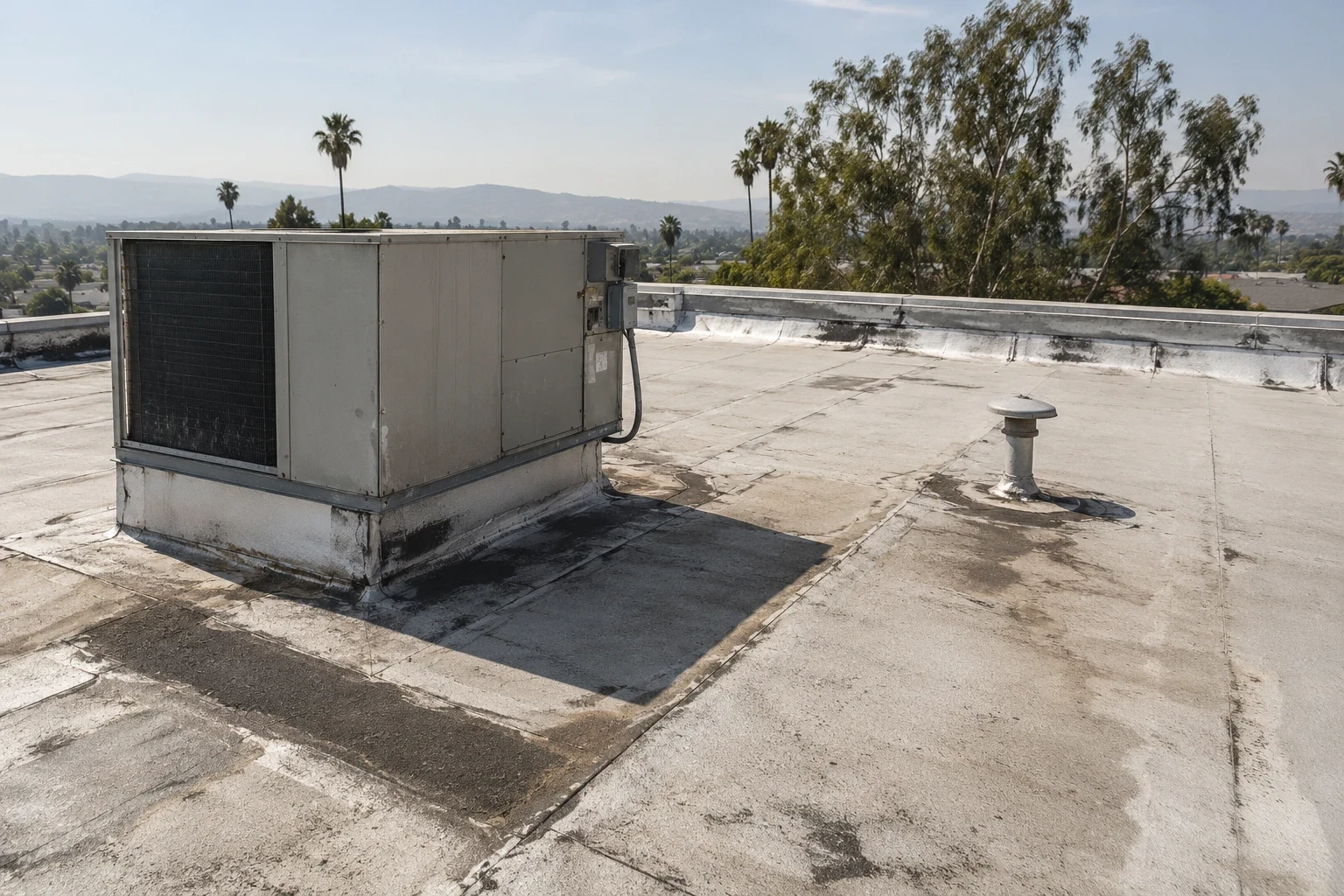
Public buildings often combine different roof ages and additions. A corridor may connect an older wing to a newer assembly, and a roof overlay can hide a change in substrate or drainage slope. Inspect the transition, terminations, expansion joints, curbs, and penetrations around each addition. At the first weak point, note whether water can move laterally before reaching the ceiling below. A drain and overflow review can be included when ponding or slow drainage is part of the complaint.
Mechanical equipment and public functions also shape the work plan. Confirm whether rooftop units must remain operating, whether alarms or communication equipment have a protected feed, and which trade is responsible for disconnecting anything. A roofer should not move equipment without an approved plan. For occupied offices, phased work in an active building can set a daily stopping point and keep a usable route to the service area.
Apply Local Context Carefully
Menifee’s zoning map distinguishes business-park/light-industrial, commercial-office, commercial-retail, and heavy-industrial/manufacturing categories, along with Economic Development Corridor subareas. Those land-use labels help explain why public properties may sit among different neighboring uses; they are not a roster of agency buildings or a map of contractor coverage. Verify the actual address, owner, roof assembly, and authorized entry for each project. For Menifee facilities, the address and authorized property contact still need direct confirmation. Planning references such as Community Core Economic Development Corridor and Newport Road Economic Development Corridor describe broad land-use context, not a public-building inventory or contractor boundary.
The City’s economic strategy identifies healthcare among Menifee’s largest employment sectors and a priority for job attraction and workforce development. That is broad city context, not a statement about any named building or agency contract. For the roof scope, rely on the inspected property and the agency’s own records. A nearby Community Core planning district is an area designation, not proof that a particular public asset lies within it.
Plan for Weather and Drainage
Menifee is described by the City as inland and naturally dry, with hotter average temperatures and more extreme-temperature days identified as climate risks. Heat exposure can make the time of day important for walking a membrane and handling materials, but it does not establish that an individual roof has failed. The field record should note surface conditions at inspection and whether the system is firm, blistered, split, or otherwise distressed.
Before a forecast rain, prioritize an active leak that threatens records, electrical equipment, public-service space, or a critical interior finish. A temporary measure should be safe, documented, and limited to the verified water route. Do not cover a drain, exhaust, or required opening while trying to stop water. After a storm, record whether the wet area grew, stayed fixed, or dried; that observation helps separate a recurring entry point from residual moisture.
Document Acceptance
At closeout, the agency receives a marked roof plan, dated photographs, repair materials and locations, test results if performed, warranty paperwork when applicable, and any remaining exclusions. The acceptance walk should confirm that drains are clear, debris is removed, equipment is accessible, and barriers are gone only after the authorized person releases the area. If a concealed condition changed the scope, preserve the approved change order with the final map.
A first-rain follow-up can be scheduled for a repair where the source was difficult to isolate. The report should state exactly what rain event or test would count as a useful next check, rather than promising a result outside the repair boundary. Public agencies can then update the asset register and procurement file without converting a one-roof observation into a general claim about every building they own.
Related details are covered in school-district roof records. Related details are covered in healthcare facility coordination. Related details are covered in government-building roof scope.
Commercial Roofing Questions
What should an agency collect before an inspection?
Share roof plans, repair and leak records, warranty information, access rules, and the names of staff who can approve testing or escort the crew.
Can a repair be bid while the building remains open?
Often, if the agency approves a defined work zone, protected public route, staging area, and interior handback. The building contact decides which services can remain available.
How are concealed conditions handled?
The scope should identify a stop-and-approve process. The contractor documents the finding, proposed boundary change, and price basis before opening additional areas.
Does city zoning identify agency roofs?
No. Zoning is land-use context. Each facility, ownership record, access permission, and roof condition must be verified separately.
What belongs in acceptance documents?
Include a roof map, dated photos, repair limits, materials, test notes, warranty documents when applicable, and unresolved conditions.
Related Roofing Work
Coordinate a commercial roof review
Request a Roof Assessment
Arrange a roof inspection with the facilities contact and procurement lead. We will document observed conditions, access limits, repair boundaries, and the records needed for your next decision.
Service area
Menifee, Perris, Murrieta, Temecula, Hemet, Lake Elsinore and nearby Inland Empire communities
Quick contact
[email protected]
555-555-5555